NearNest
Post what you need. Find who can do it. Buy, sell, hire and connect locally.
- Full-stack developer — web, mobile, API and admin platform
- —
- 2026
- In development
Overview
NearNest is a full-stack hyperlocal platform where people hire nearby service providers through a bid system, buy and sell items with offer negotiation, and chat in real time. It includes verification, subscription plans, an admin portal and native Android and iOS apps.
Problem
What was actually wrong.
Finding a reliable local service provider or selling a used item often means navigating scattered classifieds and phone calls. NearNest brings local discovery, negotiation, communication, payments and trust tools together in one location-aware platform, built for Indian cities and launching in Indore.
Goals
- Bring local services, gig requests and buy-and-sell listings together in one platform
- Let customers compare provider bids and let buyers and sellers negotiate directly
- Support one account across customer, provider, buyer and seller roles
- Build trust with verification, reviews, moderation and protected contact details
- Ship a consistent experience on the website and native Android and iOS apps
Solution
The approach taken.
NearNest combines service discovery, customer-posted requirements, provider bidding, marketplace listings, offers and rich messaging. A single account can switch between customer, provider, buyer and seller roles, while a separate admin portal handles operations. The Next.js application also ships to Android and iOS through Capacitor, with native capabilities such as GPS, push notifications, deep links and offline handling.
Architecture
One account, multiple roles
Customers, providers, buyers and sellers use the same account and switch roles with a toggle, avoiding separate accounts for different ways of participating locally.
Location-aware service marketplace
Provider search and gig discovery use location alongside rating, price, experience and verified status. Customers set a radius and budget for a requirement, then compare bids and accept a provider.
Negotiation and communication
Marketplace offers and counter-offers, service quotes and rich chat keep negotiation in the platform. Phone numbers are unlocked only after an offer is accepted.
Web and native mobile delivery
Next.js 16 and React 19 power the app, with Capacitor 8 providing Android and iOS packaging and native integrations such as GPS, push notifications, sharing, haptics and deep links.
Administration and monetization
A separate admin portal supports verification, moderation, disputes, refunds, revenue analytics, CMS content and platform settings. Free, Pro and Business plans, credit packs, boosts and a wallet support monetization.
Technologies
Application
- Next.js 16
- App Router
- React 19
- TypeScript
- Tailwind CSS v4
Data and state
- Prisma 7
- MySQL
- Zustand
- Optimistic server-synced actions
Mobile
- Capacitor 8
- Android
- iOS
- Native GPS
- Push notifications
Key features
Nearby provider discovery
Search and compare local providers by distance, rating, price, experience and verified status. Profiles support calls through a masked number, chat and quote requests, while city and category pages are designed for SEO.
Requirements and provider bids
A three-step wizard suggests a category from the customer’s description, detects urgency and captures radius and budget. Nearby providers bid on the work; customers compare bids, accept one, track the job and leave reviews when it closes.
Buy-and-sell marketplace
Local listings support filters, offers, counter-offers and paid boosts so buyers and sellers can negotiate within the platform.
Rich, safer messaging
Conversations support text, images, documents, locations, voice notes, quotes, offers and job cards. Users can block or report, and phone numbers are revealed only after an offer is accepted.
Verification and reputation
Mobile, email, identity and business checks, skill badges and reviews help users assess trust before starting a transaction.
Plans, payments and platform operations
Free, Pro and Business plans work alongside credit packs, listing boosts, a wallet and GST invoices. The admin portal includes KPIs, verification queues, moderation, disputes, refunds, analytics, CMS and settings.
Multilingual support chatbot
A custom intent-matching support bot is designed to understand English, Hinglish and typos, with an accuracy test suite for evaluating its responses.
Native mobile capabilities
The Capacitor apps integrate push notifications, GPS, sharing, haptics, deep links and offline handling, with app-style navigation and bottom sheets.
Process
Discover
Bring service requests, local listings, provider profiles and community connections into a single location-aware experience.
Match
Connect requirements to nearby providers through radius-based discovery and competitive bids, and let buyers and sellers negotiate listings with offers.
Build trust
Keep communication and negotiation in the platform while supporting verification, reviews, moderation and controlled sharing of contact details.
Go local
Prepare the product for launch in Indore, with SEO-friendly city and category pages and mobile apps that use native device capabilities.
Screens
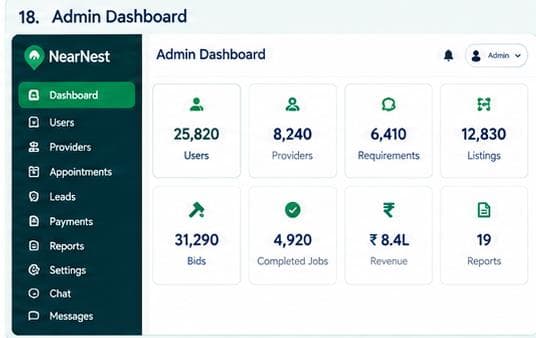
Platform administration dashboard 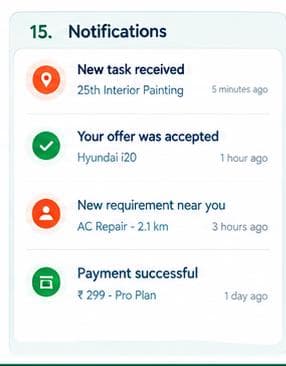
Real-time activity notifications 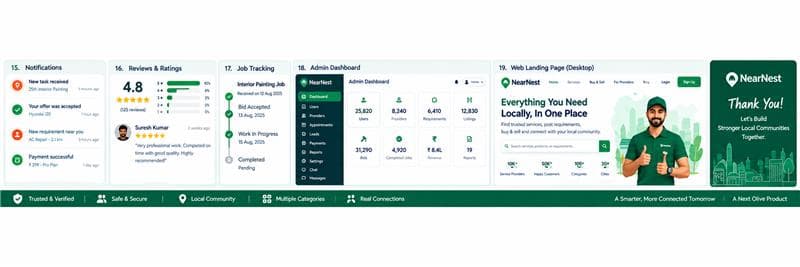
Marketplace and community experience 
Local provider experience
Challenges
What went wrong first.
Multiple marketplace workflows in one product
Service requests use provider bids, while product listings use offers and counter-offers. Both need clear negotiation and completion flows without confusing the experience.
Flexibility with trust boundaries
Users can take on different roles, but verification, reporting and controlled phone-number sharing help preserve trust as they connect and transact.
One application across web and native apps
The product needs to remain useful on the website and on Android and iOS while mobile users also expect native GPS, notifications, sharing and offline behavior.
Learnings
- Different kinds of local transactions need negotiation flows tailored to the job or item rather than one generic checkout.
- Combining flexible user roles with clear trust and contact-sharing rules helps a local marketplace stay approachable.
- Native mobile features are valuable when they support the core local workflows, such as discovery, timely notifications and sharing.
OneStoryPlanet
Authentic personal stories, beyond the feed.